Location
Get in Touch
More in The Scottish Borders
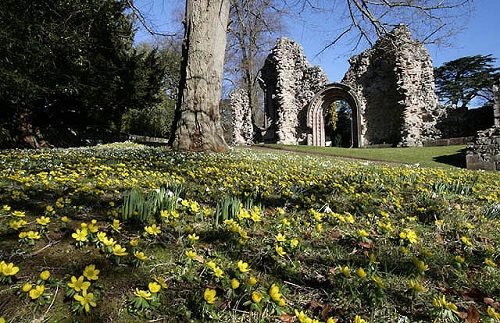
Mertoun Gardens
Little is known of the early history of the gardens. It is assumed from the great age of many of the specimen
trees that they were laid out at the time Mertoun House was built or possibly prior to that as Old Mertoun House,
part of which is now the head gardener's house in the walled garden - dates from 1677 and the circular dovecote from
1567.
26 acres of grounds surround Mertoun House, built in 1703. Set within the walled garden is an even earlier 1677 house,
now used as the gardener's cottage. Another historic highlight is a dovecote built in 1567. Mertoun stands beside River
Tweed, in glorious Borders countryside near Melrose.
To the north-east of the house is a wide expanse of sweeping lawn, bounded to the east by the tree-covered bank of the Tweed and
to the north by borders of herbaceous plants, shrub roses and azaleas. Beyond is an arboretum, established over the last 60 years,
with a great variety of both conifers and hardwoods. Paths and grass walks provide access to all parts of the garden and its
surrounding woodland, as well as forming several most attractive circular walks, with views over the River. Bridges cross the
Maidenhall Burn which runs through the garden into the Tweed.
Mertoun Kirk stands within the grounds, but it is not open to members of the public except for Church Services.
Jedburgh Abbey
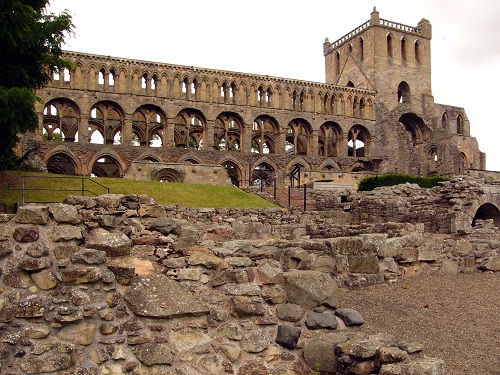
Jedburgh Abbey, a ruined Augustinian abbey which was founded in the 12th century, is situated in the town of Jedburgh, in the Scottish Borders, 10 miles north of the border with England at Carter Bar. Jedburgh Abbey lies on south facing slopes on the north bank of the Jed Water, close to the centre of Jedburgh. It was founded, initially as a priory, by King David I in 1138. His intention was partly to demonstrate to the English that the Scots could build on a grand scale so close to the oft disputed border between the two countries. In doing so he was tempting both fate and the English: and the result was not always a happy one for the abbey. David had another reason for founding Jedburgh Abbey here. This site was probably the one used for a church built by Bishop Ecgred of Lindisfarne in 830. A beautifully carved fragment of a shrine on display in the visitor centre dates back to the 700s and suggests that even Bishop Ecgred was not the first Christian to worship here. The community of friars at Jedburgh was initially established by Prince and later King David I in the 12th century, with the church gaining full abbey status around 1147. Unlike many of the border abbeys, which sit in secluded glens or fields, Jedburgh Abbey is situated in the centre of the town, and various portions of the structure were added across several hundred years.
Rosslyn Chapel
Rosslyn Chapel, also known as the Collegiate Chapel of Saint Matthew, is a 15th-century Episcopal chapel located in the village of
Roslin in Midlothian, Scotland. The chapel was founded by William Sinclair, 1st Earl of Caithness with a ground-breaking ceremony in
1456.
The beauty of its setting, in rural Midlothian, the mysterious symbolism of its ornate stonework and its role in the Da Vinci Code
have inspired, attracted and intrigued writers, artists and visitors ever since.
Just seven miles from Edinburgh city centre and open daily. Each day is split into 90-minute timeslots, allowing them to manage the
capacity on site.
After the Scottish Reformation in 1560, it was largely abandoned but, following a visit by Queen Victoria, it was rededicated in 1862. It was the
target of a bombing in 1914 during the suffragette bombing and arson campaign. The interior contains some fine carvings which many historians have
sought to interpret. Since the late 1980s, the chapel has been the subject of speculative theories concerning a connection with the
Knights Templar and the Holy Grail, and Freemasonry. It was prominently featured in this role in Dan Brown's bestselling novel The Da Vinci
Code (2003) and its 2006 film adaptation. Medieval historians say these accounts have no basis in fact. Rosslyn Chapel remains privately owned.

Follow Us
 Facebook
 Instagram
 Twitter
 YouTube